

Not sure which Colombia tour to choose? Click to see a complete listing and comparison of all our Colombia trips.
The Sierra Nevada de Santa Marta is reputed to be the tallest coastal mountain range and to have the highest concentration of continental range-restricted birds in the world. How do you measure this stuff? In any case, we will accept the claims as true because they are good for business, and we will tell you about the great lodge at ProAves' Reserva Natural de las Aves ("RNA") El Dorado that makes visiting this famous birding spot so much easier than Field Guides' first planned tour to this area in 1992. Rooms with private facilities are set on luxurious forested slopes and are just a minute through the lovely gardens from the main lodge. And if you are looking for avian gold, El Dorado is the place. Located at 6300 feet (1900m), the lodge is near the center of the reserve, which extends from 3000 to 8700 feet (900 to 2600m) on the San Lorenzo ridge, an outlying ridge above the town of Santa Marta, on the northwest flank of the Santa Marta range. All but three (Santa Marta Wren, Santa Marta Sabrewing, and Blue-bearded Helmetcrest) of the Sierra's endemic species occur on this ridge. We have a good chance for the remainder, although species such as woodstars and antpittas present their own challenges. The higher elevations of the central massif, where the paramos are home to the SM Wren and Helmetcrest, are on indigenous lands with restricted access and require a long, rough hike and basic camping to reach… which is why we don’t plan to target them on the tour anytime soon. You understand, I'm sure. The SM Sabrewing has been a mystery bird for decades, with only a couple questionable records until 2022, when it was rediscovered on the southeast flank of the range in drier habitats. At this time, there is no tourism infrastructure there.
Fortunately, at our El Dorado Lodge, the road from Santa Marta ends in a series of communication towers and an army camp, and the San Lorenzo ridge is one of the few accessible areas with temperate cloudforest habitat. As for the main Sierra, the best we can do is hope for a clear morning from the ridge top so that we can photograph the snowy peaks, such as Pico Colón (Colombia's highest peak), that rise to over 19,000 feet (5700m).
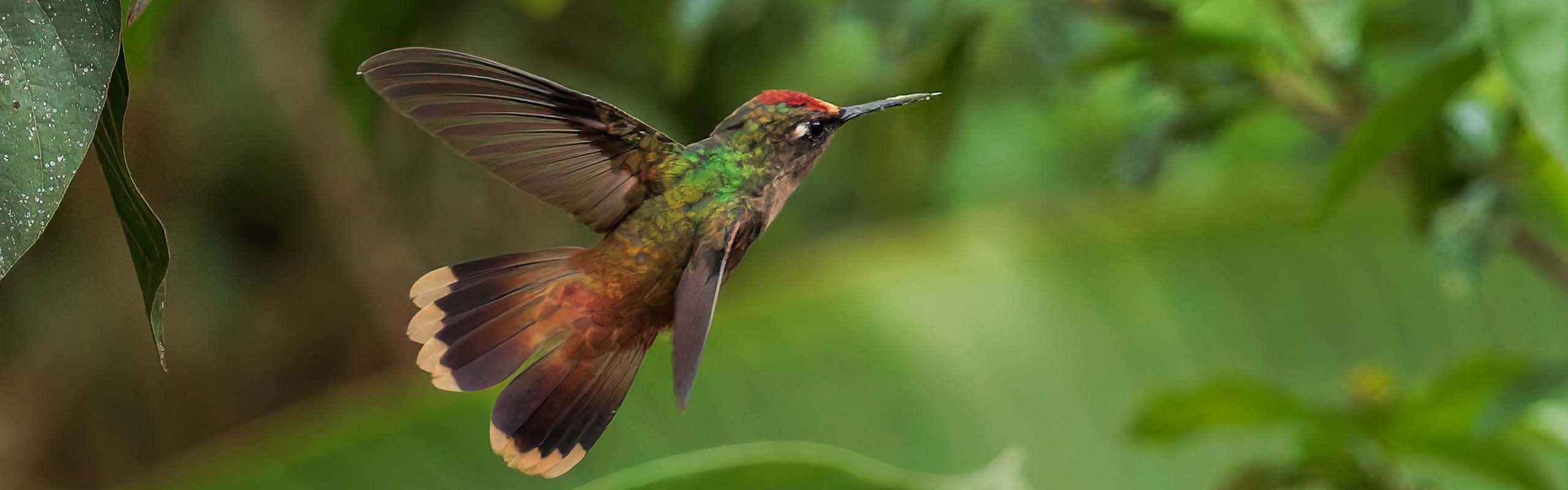
"Endemics" does not just mean little brown jobs (LBJs). The 15 or so species that have long been considered endemic are not only distinct but often striking. White-tailed Starfrontlet is bold (both sexes, different as they are). Santa Marta Warbler (Vulnerable) looks like the Three-striped Warbler of the main Andes but is actually more closely related to Citrine Warbler. Santa Marta Parakeet (Endangered), Black-backed Thornbill, Black-cheeked Mountain-Tanager, and Yellow-crowned Redstart are variations on an Andean theme, but they are fine themes. Santa Marta Bush-Tyrant (Endangered), Sierra Nevada (formerly Rufous) Antpitta, and Santa Marta Antpitta (Vulnerable) aren't quetzals but are too large to be LBJs… maybe MSBJs (=Medium Sized Brown Jobs)? Brown-rumped and Santa Marta tapaculos are emphatically LGJs (G = gray), but you can't have everything. On the other hand, the Rusty-headed Spinetail (Vulnerable) and Sierra Nevada and Santa Marta brushfinches are quite attactive. And recently, the distinctive genus of blossomcrowns has been split: Santa Marta Blossomcrown (Vulnerable) is an understory hummingbird that requires some sharp eyes to find, even in the planted gardens that are our best chance.
The factoid about "continental range-restricted birds" has the qualifier of "continental"; many oceanic islands have more endemics. Of course, the Sierra Nevada is an island of a different kind, a biogeographic island on land (similar idea to the "Sky Islands" of Arizona), hence the endemism, with over 60 named endemic avian taxa (that is: subspecies as well as species). The nearby Sierra de Perija, the somewhat depauperate northern extent of the main Andes and itself a center of endemism, is a mere 35 miles (60 kilometers) from the southwestern flank of the Sierra Nevada de Santa Marta, and the full richness of the eastern Andes is a further 140 miles (200 km) away. While the lowlands are certainly a barrier to avian dispersal, much remains to be understood about the birds of the Santa Martas. For instance, is the lack of bush-tanagers (along with the limited selection of Tangara tanagers) because these species are poor colonizers, or because despite the lushness of the Sierra's forests, not enough tanager essentials (fruiting trees, insects) have also colonized this continental island? How did some paramo and treeline species such as the tapaculos, helmetcrest, and thornbill get here, but so many other widespread Andean species never make it (or made it but subsequently went extinct)?
A visit to the Sierra Nevada de Santa Marta will also allow us to play taxonomist. While we will look hardest for the endemic species accepted by all, we will look for everything on the mountain because we are birders who enjoy seeing as much as possible. In the process we will see montane taxa that range from being indistinguishable from populations in the Andes to those considered endemic species by all authorities. In between are some subspecies that seem particularly intriguing, differing in appearance and voice, such as Masked Trogon, Montane Woodcreeper, while in others the differences are noticeable but seem "cosmetic," such as Tyrian Metaltail, Southern Emerald-Toucanet, and the extra-cinnamon Cinnamon Flycatcher. Other great tropical birds with local representatives include Sickle-winged Guan, Strong-billed Woodcreeper, and Swallow Tanager. In one intriguing case, some of the Gray-breasted Wood-Wrens have been split and live one above the other on the slopes--the higher-elevation Hermit Wood-Wren was granted full species level, but the lower subspecies has yet to be split from other populations of Gray-breasted (although this may yet happen). These are judgment calls, about which there will be many opinions; we will point out every bird we can find, and we'll leave with not just a high concentration of checkmarks in front of range-restricted taxa, but an appreciation for the island biology of the Santa Martas.
While most of the region's birds had been found by the time of W. E. Clyde Todd & M. A. Carriker Jr.'s classic The Birds of the Santa Marta Region of Colombia: A Study in Altitudinal Distribution (1922), the age of discovery is not over. A recently described (2017) species of screech-owl (conveniently named Santa Marta Screech-Owl) is found around our lodge; it is most likely the mystery screech-owl on which Todd and Carriker reported on the basis of one distinctive specimen, but now its voice and appearance are well known, and it is something we will endeavor to see. Niels Krabbe's recent studies, published in 2008, demonstrated that what had been treated as a subspecies of Ruddy Foliage-gleaner is a distinct species--again, rather thoughtfully named the Santa Marta Foliage-gleaner--and further genetic studies have merged it into Clibanornis with Canebrake Groundcreeper and a few other foliage-gleaners; we will search for this skulking endemic. A 2012 study elevated the Santa Marta (Long-tailed) Antbird to species status; this endemic is unusual among its siblings in inhabiting lower-elevation bracken rather than high-elevation bamboo. And in 2015, and again in 2024, a mysterious population of large antpitta that bears a strong similarity to Undulated Antpitta has appeared in the El Dorado area. It is not yet clear whether this is best considered a subspecies of Undulated or could be a new species… time will tell.
The affinities of the Sierra Nevada de Santa Marta are not just with the Andes to the south, but also with the cordillera of Venezuela. Some species also seen in the Venezuelan ranges are Band-tailed Guan, the stunning White-tipped Quetzal, Groove-billed Toucanet, Rusty-breasted Antpitta (nominate), Spectacled Tyrannulet (formerly part of Paltry Tyrannulet, scarce here), Golden-breasted Fruiteater (also in the northwestern Andes), Yellow-legged and Black-hooded thrushes, and Black-headed Tanager. Many of these are characteristic of moist, not wet, forests.
The habitats of the Santa Martas are a complicated mix of dry and wet, depending on rainfall distribution in relation to exposure to moist winds and elevation. The upper parts of the San Lorenzo ridge catch the clouds and support wet forest, but lower down, and generally to the north and east, many areas are drier. As you would expect, endemism decreases at lower elevations, but the semi-deciduous forests at lower elevations do support some local and special birds, including Military Macaw (we need a lucky flyover, but they are around; Vulnerable), Coppery Emerald (an erratic altitudinal migrant), Black-backed Antshrike, Pale-eyed Pygmy-Tyrant, Rosy Thrush-Tanager (tough), and the gorgeous Golden-winged Sparrow. Other birds in these areas include Steely-vented Hummingbird, White-vented Plumeleteer, White-bearded Manakin, Golden-fronted Greenlet, Long-billed Gnatwren, and Chestnut-capped Warbler (recently split from the Middle American Rufous-capped). More mesic areas of the lowlands and lower slopes support a variety of classic tropical species, including King Vulture, Rufous-tailed Jacamar (but a form with a ridiculously long tail that is found on the arid Caribbean coast of Colombia and Venezuela), Keel-billed Toucan, Collared Aracari, Crimson-crested Woodpecker, Boat-billed Flycatcher, Rufous-breasted and Rufous-and-white (great voice) wrens, and Crimson-backed Tanager. These lower slopes have suffered more than a century of abuse, and birds that have retreated to remote patches (we won't be able to visit) include a mystery tinamou (a Red-legged type) and the critically endangered Blue-billed Curassow; nor do we expect to see Crested Guans, which were seen by Carriker a century ago at a rate of 40-50 in a "half-day's tramp through the woods."
It's a lot of great birds to see and enjoy, so what are you waiting for?We'll see you in this little corner of paradise, and don't forget your binoculars!
Select the KEY INFO tab or click here for our itinerary plus space requests, status, fees, limits, and guides for any departure.
Combo Tours
If you would like a longer birding holiday, some departures of this tour may be combined with:
COLOMBIA'S EASTERN CORDILLERA