

Not sure which Costa Rica tour to choose? Click to see a complete listing and comparison of all our Central America trips.
Costa Rica, one of the smallest countries in the New World, is proof that good things do come in small packages, at least where birders are concerned. The diversity of habitats, excellent tourism infrastructure, and extraordinary number of bird species, all within a country smaller than most US states, make it a premier birding destination and a role model for other developing countries that would like to enhance their images as ecotourism destinations. The only problem is, there are so many great places to go that it's pretty much impossible to visit them all in a single trip! With that in mind, we've designed these two tours to complement our long-running, classic COSTA RICA tour, visiting some areas and targeting some birds that we just don't get to on the "classic." Note: while we will have a chance to see Resplendent Quetzal on these tours, the highlands occupy a relatively small portion of these itineraries so we won't have much time to pursue quetzals if they don't present themselves readily. If you're really on a quetzal-focused quest, please consider our March Classic Costa Rica tour.
Part One takes us south of the capital city of San Jose, along the spine of the Talamanca Mountains, and down near the Panamanian border, where we'll track down a bunch of species that occur nowhere other than in Costa Rica and its neighbor to the south. We'll break up the long drive south with some birding in the montane forests and paramos of Cerro de la Muerte (where a host of Chiriqui highland endemics may be found, including a slim chance of Resplendent Quetzal) and a two-night stay in San Isidro, with a visit to Los Cusingos, former home of the late, great naturalist Alexander Skutch, author of the original field guide to Costa Rica's birds. Here, we'll enjoy some of the species that were the subjects of Skutch's many writings on tropical birdlife, perhaps including the showy Fiery-billed Aracaris for which the site is named, or even the dazzling Turquoise Cotinga, before arriving at our primary destinations near the border.
Once we've arrived in the deep south, we'll divide our time between two main sites, each with a very different mix of birds. Starting in the mountains, we'll base ourselves at the beautiful Wilson Botanical Gardens near San Vito. The gardens and surrounding areas are home to a good variety of mid-elevation species, including a number of southern specialties. Hummingbirds are well-represented here, with White-tailed and Garden emeralds, Snowy-bellied and Charming hummingbirds, and White-crested Coquette among the possibilities. Other specialties of the south that we could encounter here include the elusive Ruddy Foliage-gleaner, the recently split Chiriqui Foliage-gleaner, Baird's Trogon, and Costa Rican Brushfinch, in addition to a wonderful assortment of more widely occurring species. Marshes and grasslands in the region can be good for such things as Bran-colored Flycatcher, Pale-breasted Spinetail, and the local race of Olive-crowned Yellowthroat, which is sometimes treated as a separate species, the Chiriqui Yellowthroat.
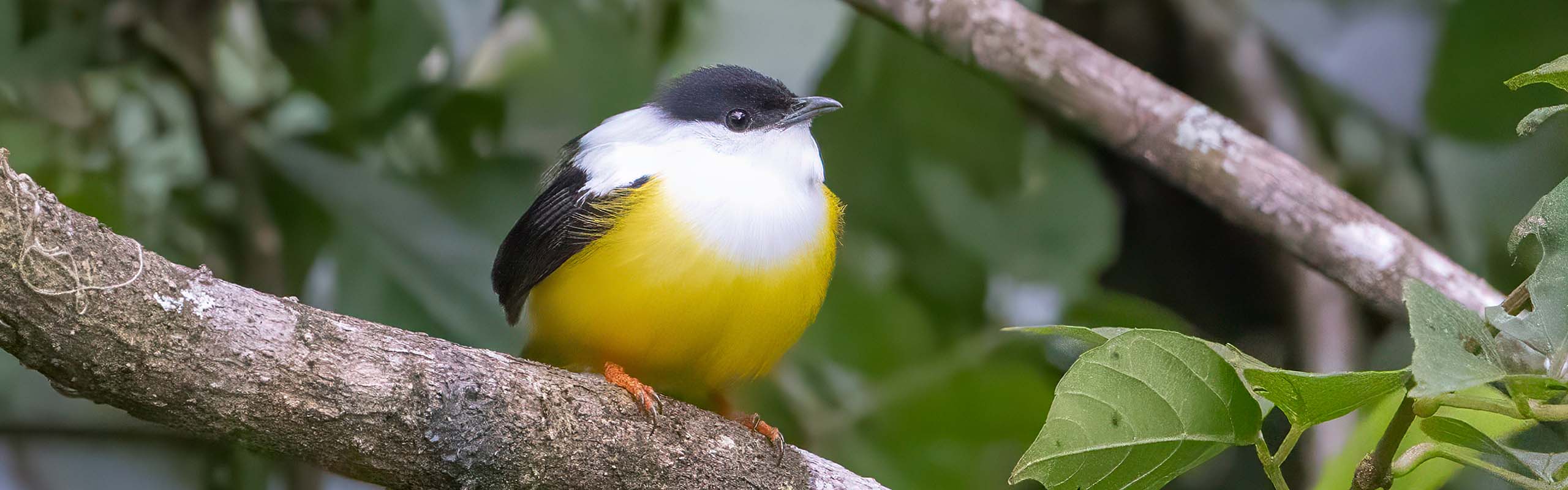
Our second southern destination is in the lowlands near the Pacific coast, at the fantastic Esquinas Rainforest Lodge. The area's star bird is the beautiful Black-cheeked Ant-Tanager, endemic to this small corner of Costa Rica and a regular visitor to the grounds of the lodge. Among other regional specialties to be found here are Band-tailed Barbthroat, Golden-naped Woodpecker, Black-hooded Antshrike, the immaculate Yellow-billed Cotinga, and snappy Orange-collared Manakins. In recent decades, a number of species new to the Costa Rica list have been found in this region, including Brown-throated Parakeet, Veraguan Mango, Sapphire-throated Hummingbird, and Crested Oropendola, and we'll try to find some of these recent arrivals as well. Our return to San Jose will take us up along the coast and offers a chance of more new species, including the possibility of showy Scarlet Macaws in the Carara region.
Part Two begins where Part One ends, at our excellent hotel near San Jose, from where we will head northward towards Nicaragua. We'll begin with a visit to Poas Volcano National Park and the La Paz Waterfall Gardens for some great highland birding and a mind-boggling array of hummingbirds to start things with a bang (or a buzz, really!). We could end the first day of birding with close to 15 species of hummingbirds, including massive Violet Sabrewings and the diminutive endemic Coppery-headed Emerald, as well as a fine assortment of other mid to high elevation birds from Prong-billed Barbet to Northern Emerald-Toucanet to Sooty-faced Finch. We'll continue our exploration of the bird-rich middle elevations during a two-night stay at the wonderful, secluded, Bosque de Paz. The lush cloudforest here abounds with birds, with a good selection of Furnariids including Red-faced Spinetail, Spotted Barbtail, Streak-breasted Treehunter, Lineated Foliage-gleaner, Tawny-throated Leaftosser, and the rare Black-banded Woodcreeper, plus a number of Chiriqui endemics like Black Guan (probably the best site for them), the elusive Silvery-fronted Tapaculo, Yellow-thighed Brushfinch, and Golden-browed Chlorophonia. Feeders at the lodge attract in a variety of birds, as well as mammals such as White-nosed Coatis, and, after dark, the rarely-seen Paca, an agouti-like large rodent with white spots.
Next, we'll visit the vast wetlands of Caño Negro in the far north. Located in the Lake Nicaragua lowlands, the Caño Negro region has a unique mix of birds, primarily Caribbean slope species, but with several typically Pacific slope birds and some northern Central American species found nowhere else in the country. Boat trips through the extensive wetlands system should turn up a tremendous variety of wetland birds including Sungrebe, Russet-naped Wood-Rail, and American Pygmy Kingfisher, and with luck, a rarity or two in the form of Pinnated Bittern, Yellow-breasted Crake, or Agami Heron. The boat trips also offer us our best chance at the very local Nicaraguan Grackle, found only in the Lake Nicaragua lowlands. Forests and grasslands adjacent to the wetlands offer up local specialties like Gray-headed Dove, Spot-breasted Wren, and Nicaraguan Seed-Finch, and nocturnal birding can be productive too, with both Common and Great potoos, Pacific Screech-Owl, and Black-and-white and Striped owls among the possibilities.
We'll finish up the tour with a three-night stay at the foot of what was once Costa Rica's most active volcano, Arenal. The Caribbean foothill forests here support a superb array of birdlife with groups like hummingbirds, antbirds, and tanagers all well-represented. From these three groups alone we hope to track down gems like Black-crested Coquette and Violet-headed Hummingbird, Ocellated, Spotted, and Bare-crowned antbirds, and Rufous-winged and Emerald tanagers. The Arenal region is also the best place in Costa Rica (and perhaps anywhere) to see the very local Keel-billed Motmot, while Great Curassow, Ornate Hawk-Eagle, Lovely Cotinga (rare), White-ruffed Manakin, White-throated Magpie-Jay, and Song Wren are just a few of the many other enticing possibilities to be searched for here. And while the volcano is no longer reliable for the once regular light and sound shows, the perfect volcanic cone provides a stunning backdrop for birding in this rich region.
Whether you've already done our "classic" Costa Rica tour and want to come back for more or this is your first visit to this tropical paradise, these two tours are sure to provide you with an unforgettable experience and an impressive list of fabulous tropical birds. Come join us for a winter getaway (short or long) and see for yourself why Costa Rica is among the top birding destinations in the Americas!
Note: If you'd like to visit Costa Rica at a different time of year, we offer other tours in March and December.
Select the KEY INFO tab or click here for our itinerary plus space requests, status, fees, limits, and guides for any departure.
Client comment
"The experience could not have been better. The guides were first rate; the participants were friendly and interesting; the organization of the overall trip and the individual days was impeccable; the places we visited were all well chosen; and the lodges were very good. It is clear that Field Guides really cares both about the big picture of putting together a birding tour and also about the fine details that make all the difference in turning the big picture into an enjoyable day-to-day experience for everyone." J.T., COSTA RICA: BIRDING THE EDGES tour participant