

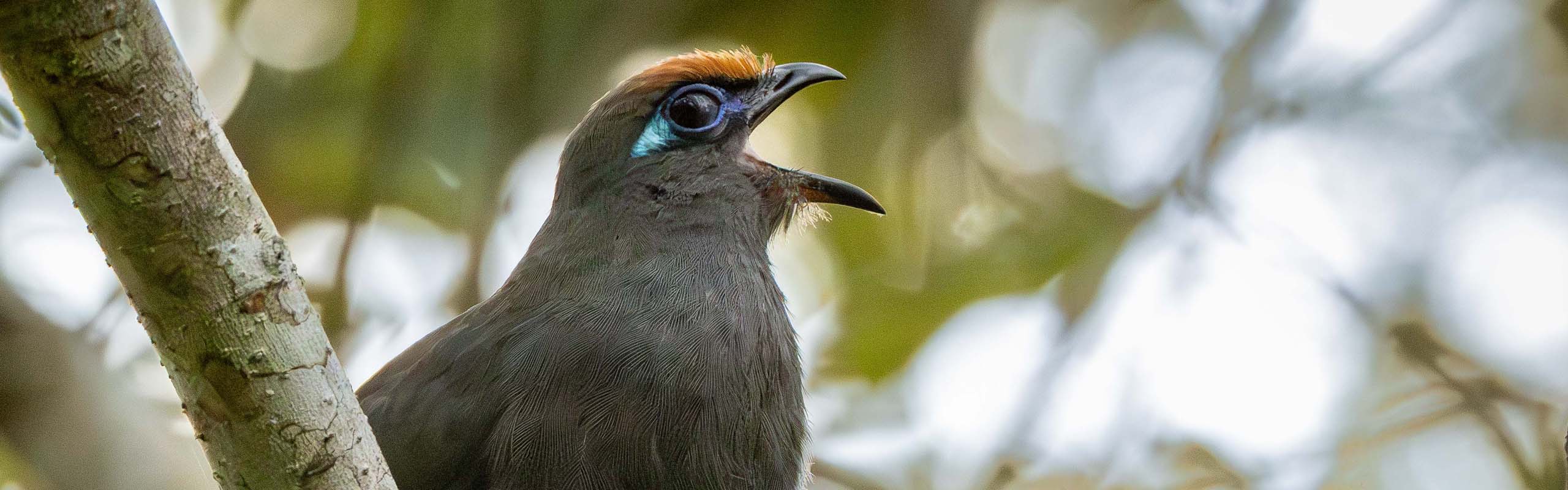
Madagascar is the fourth largest island in the world, but it has been separate from Africa for so many millions of years and has fostered the preservation and evolution of such a multitude of unique life forms that it is considered one of the major zoogeographic regions of the Earth. Ninety percent of its forest species are unique, as well as all of the native Malagasy land mammals, among them what are now recognized as 105-plus species of lemurs, an ancient primate group once widespread but now largely confined in shrinking numbers to Madagascar. More than half of the 250-plus bird species are endemic, including about thirty-six genera and six families of birds found only here or the nearby Comoros: the mesites, the Cuckoo-Roller, the ground-rollers, the asities (now placed with broadbills), the Bernieridae (Malagasy tetrakas and warblers), and the vangas. In addition, the couas comprise a bird subfamily endemic to Madagascar. Our tour visits all the major zoogeographic regions of the island, from xerophytic spiny forest near Tulear to deciduous tall forest near Mahajunga in the northwest and lush eastern rainforest at Mantadia-Andasibe (Perinet) and Ranomafana. This broad coverage, with intensive birding in the best locales, gives us an excellent chance to find representatives of all the endemic bird families as well as the endemic genera. Our tour route includes localities for more than 110 of Madagascar's endemic birds--a little more than a dozen remaining species being either nearly extinct, virtually unknown, highly localized, or inaccessible to groups. And though the proportion of endemics in Madagascar's avifauna is remarkably high, participants have an excellent chance of seeing most of these birds. We expect our past discoveries (including that of a new species of warbler, the Cryptic Warbler) and our extensive recording collection to serve us well on our upcoming tours to Madagascar, where Field Guides began running tours forty years ago back in 1986, a well-established pedigree! And with the assistance of several recent field guides to the birds and mammals, there is every reason to visit this remarkable island now.
Seeing so many unique and often bizarre birds--Sickle-billed Vanga, Sunbird Asity, Blue Coua, or Long-tailed Ground-Roller--makes for exciting birding indeed. And Madagascar offers many spectacular pluses. Most numerous and conspicuous of the indigenous mammals are the lemurs. A very few small, nocturnal relatives of lemurs survive in Africa, but only in Madagascar do lemurs still inhabit the daylight world, in graceful and beautifully colored and patterned forms to more than three feet tall. We should see 20 or more species of lemurs, including the nearly all-white sifakas and the tiny mouse lemurs, smallest of all primates. The misty forest of Perinet can have an unforgettable dawn chorus of Indri with their astonishing Humpback Whale-like vocalizations. We'll also have opportunities to see families of Ring-tailed Lemurs near Isalo, while Lesser Vasa Parrots and Cuckoo-Rollers are other species we should see and hear during our time here. It is truly amazing to feel one is returning to a living remnant of the Miocene era--the Earth as it might have appeared fifty million years ago when the last significant immigration of African species to Madagascar occurred.
You will see, too, we are sad to report, that Madagascar is an island lost in more than time. Humans did not reach Madagascar until about 500 C.E. The incredible natural world those first visitors found is now largely despoiled and lost forever. On Madagascar, eleven species of lemurs and the twelve-foot-tall Elephant Bird (Aepyornis), the largest bird that ever lived, were exterminated by hunting and by man-made fires that stripped the island of more than eighty percent of its forest cover. Few areas on Earth have so many species listed as endangered or threatened. Fortunately, the island has been the focus since the 1980s of a concentrated conservation effort by international organizations in concert with the Malagasy government, and the outlook for preservation of areas representative of all of Madagascar's habitats may be improving slightly with combined efforts from many overseas and local organizations. Our tour supports many local guides and workers, and we make a significant contribution to the local village economies, which is gratifying.
Select the KEY INFO tab or click here for our itinerary plus space requests, status, fees, limits, and guides for any departure.
Client comment
"Wonderful and unforgettable. Best features of the tour were the lemurs and the beautiful, exotic birds...couas, vangas, ground-rollers, cuckoo-rollers, mesites, asities. Your office service was superb." E.C., MADAGASCAR