

Not sure which Peru tour to choose? Click to see a complete listing and comparison of all our Peru trips.
Manu Biosphere Reserve, incorporating Manu National Park and a couple of contiguous convervation tracts, is a vast, spellbinding wilderness (the size of Massachusetts!) in southeastern Peru. It comprises the headwaters of the Rio Madre de Dios—the Mother of God River—a tributary of the Madeira, which flows into the Amazon well within Brazil. Replete with some of the richest flora and fauna to be found anywhere in South America. It offers the uncontained possibilities of an entire humid Andean Slope ecosystem, from golden grasslands of the puna zone down the eastern Andean slope through cloaking montane cloudforest to seemingly endless lowland rainforest.
This tour offers a rich transect of the incredibly “birdy” road from above Cusco down to the Alto Madre de Dios in the rich upper-tropical zone, some of the best birding in the world! The tour begins with one night at Wayqecha Biological Station at 9800 feet (3000m), thus allowing us an opportunity to bird the high-elevation forest early and late, four nights based in the cloud forest area ot “San Pedro” at 4600 feet (1400m), from which we bird up and down the road, and three nights in the rich upper-tropical foothills at 1600 feet (500m), based at Manu Biolodge. Each lodge we use offers pleasant sleeping, hot showers, good food, and good service right in the midst of excellent birding.
The scenery alone would be reason to take this tour—the copses of treeline forest that plunge down the east slope, becoming taller and wetter and more cloaking at mid-elevations, secreting streams and waterfalls and rushing rivers, in places completely covering the narrow road that snakes downslope. There are precious few places in South America where one can transect comparably undisturbed forest on the diverse east slope of the Andes. And at Manu Biolodge we will enjoy of the mosaic of habitats, such as Guadua bamboo, edge, and advanced secondary rainforest, that make this a very special place.
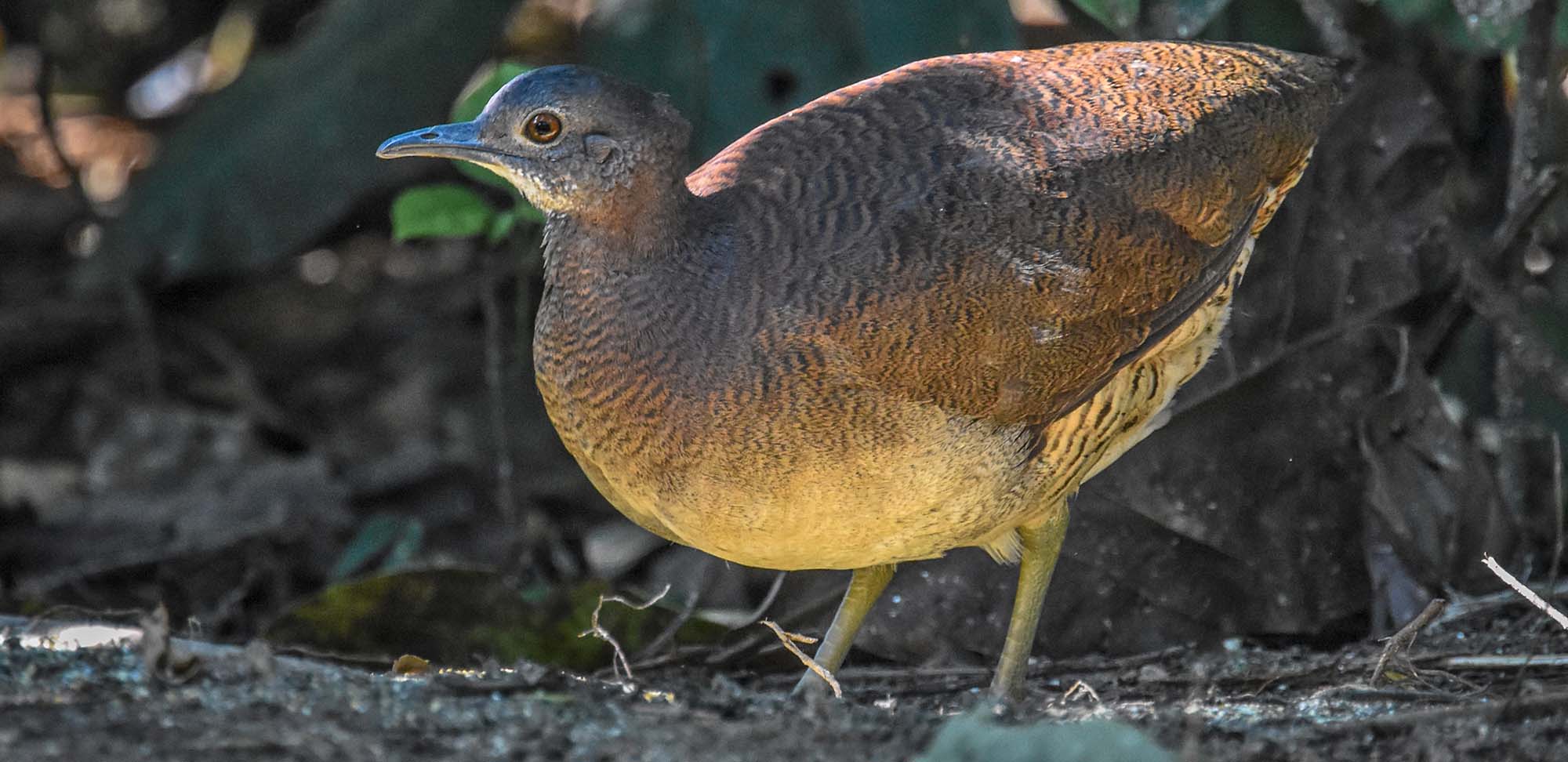
But the birds too are genuinely breathtaking—from glowing male Andean Cocks-of-the-rock and electric Whitecollared Jays to wonderfully camouflaged Yungas Pygmy-Owls, mottled in rufous, browns, and grays; from subtly beautiful Gray-breasted Mountain-Toucans gulping big fruits in the temperate forest to dazzlingly brilliant Paradise Tanagers consuming the abundant melastome berries of the middle-elevation forest edge, along with dozens of other tanagers in mixed-species flocks, a phenomenon for which the east-Andean slope is justifiably famous; from White-capped Dippers along mountain streams to Fasciated Tiger-Herons along foothill rivers; from sunning Hoatzins with their shaggy crests to a fabulous array of hummingbirds (including shaggy-crested Wire-crested Thorntails and Rufous-crested Coquettes!); from virtuoso Chestnut-breasted Wrens and Andean Solitaires to piercingly resonant White-eared Solitaires and Olive Finches “shouting” above the sound of rushing water, to mellow and persistent Tawny-bellied Screech-Owls that soothe us to sleep each night in the quiet lowlands; from shy tinamous and antpittas that circle us furtively in response to playback (and now, some perhaps even without!), to the view of a big male Amazonian Umbrellabird atop canopy trees. We’ll seek numerous range-restricted specialties, from Blue-headed Macaw, Bearded Mountaineer, Scarlet-hooded Barbet, Creamy-crested, Cabanis’s, and Marcapata spinetails, Urubamba and Red-and-white antpittas Slaty Gnateater, and Yungas and Cerulean-capped manakins, to Cinnamon-faced Tyrannulet (first described in 1997), Yellow-crested Tanager, and a few bamboo specialties more typical of lower elevations in southwestern Amazonia, including Dusky-cheeked Foliage-gleaner, Bamboo Antshrike, and Goeldi’s, White-lined, and Manu antbirds. In 8 days of birding, we should encounter more than 350 species of birds, including some of the fanciest and most sought-after in the Neotropics.
Focus of this tour: The purpose of this tour is to enjoy some of the richest birding on the east slope of the Andes while comfortably based at some wonderful lodges that give access to a wide range of elevations. In part to break up the long drive back to Cusco, and in part to buffer against a period of excessive sun (!), rain, or fog, we’ve decided to divide our stay in the cloud forest into two segments—four nights on the way down and one night on the way back up. By our second stay in the cloud forest zone, we’ll have a good sense of how to prioritize our time on our final day of birding in these cool Andes. There will be some night-birding options near each of our lodges.
Client comment
"My first time with Field Guides. I thought that I couldn't go wrong with having Dan Lane as the guide with all of his experience with the country of Peru. My assumption was correct! The trip was outstanding. Looking forward to traveling with you again." J.E., MOUNTAINS OF MANU tour participant
Select the KEY INFO tab or click here for our itinerary plus space requests, status, fees, limits, and guides for any departure.
Combo Tours
If you would like a longer birding holiday, some departures of this tour may be combined with:
IQUITOS, PERU: Canopy Walkways & Ancient Forests
PERUVIAN RAINFORESTS OF THE TAMBOPATA: Macaw