
New Guinea is a kind of ending place, at the edge of the oceans. It is a terminus of land and of life forms: from a cultural perspective, ancient and obscure; in an avian context, the ultimate stage for evolutionary achievement. This 1400-mile-long island, the largest tropical island and the world's second largest overall, lies less than 400 miles below the equator.
New Guinea's location at the juncture of two vast biogeographic regions has made it a crossroads on the pathway of evolution. A high degree of specialization is found in virtually all forms of life, including the more than 700 distinct languages spoken by native peoples. And this is the land of the fabled birds-of-paradise and bowerbirds, fascinating groups that evolved to occupy practically every habitat, from verdant rainforest to dry savanna to elfin cloud forest.
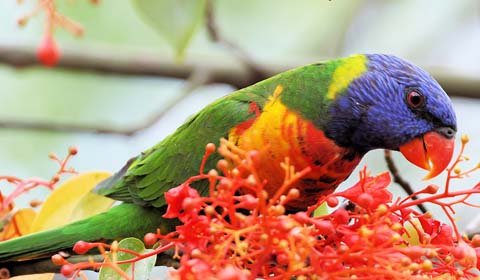
Our birding tour centers around locating a fabulous variety of birds-of-paradise, among them some of the most highly prized birds on Earth: King-of-Saxony, Twelve-wired, Raggiana, and Blue birds-of-paradise, the elegant Ribbon-tailed Astrapia, the huge Brown Sicklebill, and many more, each so uniquely plumed as to seem unrelated to the others. Parrots, pigeons, fruit-doves, cuckoos, and kingfishers are particularly well represented, while some less-familiar groups of birds form the bulk of the passerine avifauna: sprightly fairywrens, gemlike pittas, cuckoo-shrikes, whistlers, sunbirds, jewel-babblers, berrypeckers, and honeyeaters. To survey all of this diversity, our route takes us to the southern lowlands, both around Port Moresby and along the Fly River near Kiunga; the southern foothills at Varirata National Park near Port Moresby and at Tabubil; the northern lowlands at Karawari Lodge on a tributary of the Sepik River; and finally to a rich transect of the highlands above and below Ambua Lodge. Many of PNG's birds are extremely challenging to see; that's where the many years experience in New Guinea of both our company and guide distinguish us.
For all of Papua New Guinea's remoteness, travel is nevertheless quite easy and accommodations are very good. Ambua Lodge, our base for five nights in the cool highlands overlooking the Tari Valley, is one of those classic, outstanding lodges on a world scale. Most of our other stops are for two or three nights, and all are in good lodgings with private facilities, giving us the chance to explore our surroundings in this rich and special land.
The Fiji extension will target the endemics of the archipelago, including the extraordinary Golden and Lemon doves, the unique Silktail, Fiji and Black-faced shrikebills, Red and Masked shining-parrots, Collared Lory, and a variety of other Fiji specials including the very rare and recently rediscovered Long-legged Warbler and perhaps Tahiti Petrel. Beautiful surroundings and not too much travel each day add to the splendid birding. Join us for a great trip.
Download an itinerary, triplist(s), request space, and see more about this tour...
Combo Tours
If you would like a longer birding holiday, some departures of this tour may be combined with:
NEW CALEDONIA